Best AI Visibility Tools for 2027
Buyers now ask ChatGPT, Perplexity, Gemini and Google AI Overviews before they ever click a search result. AI visibility tools show how often your brand appears in those answers, which competitors are recommended instead, and what to change so AI engines cite you.
- Platforms ranked
- 5
- Platforms ranked
- Evaluation criteria
- 6
- Evaluation criteria
- Last updated
- Nov 2026
- Last updated
At a glance: our 2027 picks
- #1Share of AnswerBest for brands and agencies that want a clear share-of-answer score and a plan to improve it
- #2ProfoundBest for large enterprises with dedicated AEO teams
- #3Peec AIBest for mid-market marketing teams tracking visibility and sentiment
- #4Semrush AI Visibility ToolkitBest for teams already standardized on Semrush
- #5Otterly.AIBest for small businesses and solo marketers getting started
Why AI visibility is the new search ranking
Traditional rank trackers report where a URL sits on a results page. AI assistants don't show ten blue links. They write one answer and name a handful of brands. If your company isn't in that answer, you aren't in the shortlist.
The core metric is share of answer: the percentage of relevant AI responses that mention or recommend your brand compared with competitors. The best tools track that metric across engines, show the sources AI models cite, and turn gaps into a concrete content plan.
AI answers are also less stable than classic rankings. The same question can produce a different set of brands depending on the engine, the phrasing, the user's location and simply when it is asked. That is why one-off spot checks in a chat window are misleading, and why a dedicated tool that runs prompts repeatedly and aggregates the results gives a far more reliable picture.
For 2027 we evaluated the leading AI visibility platforms on how well they measure that picture and how well they help you improve it. Some tools are built for enterprise answer-engine teams, some add AI tracking to an existing SEO suite, and some focus on low-cost monitoring. Our ranking favors the tools that make share of answer clear, comparable and actionable.
How we ranked them
Every platform was scored against the same criteria. No vendor pays for placement.
Engine coverage
How many AI engines are tracked: ChatGPT, Perplexity, Gemini, Claude, Copilot, Google AI Overviews and AI Mode. Buyers use different assistants, so a tool that watches only one engine leaves blind spots in your reporting.
Share-of-answer accuracy
Whether mention and recommendation rates are measured across enough prompts and runs to be statistically meaningful. Because AI responses vary between runs, we favored tools that aggregate repeated results rather than reporting a single snapshot.
Competitive insight
How clearly the tool shows which competitors win each prompt and why. The most useful views make it obvious where you lead, where you trail and which rival is taking the recommendation.
Source and citation data
Visibility into the pages and domains AI engines cite, so you know where to earn coverage. Citation data is what connects an abstract visibility score to specific publications, review sites and pages you can influence.
Actionability
Recommendations and workflows that turn visibility gaps into content and PR tasks. A dashboard that only reports numbers leaves the hardest part, deciding what to do next, entirely to your team.
Value
Pricing relative to prompt volume, seats and reporting depth. We considered whether a tool's cost is proportionate to the insight it delivers for the size of team it targets.
The top 5 ranked for 2027
Share of Answer: The Best AI Visibility Tool for Measuring and Growing Share of Answer
Share of Answer takes the top spot because it is built around the one metric that matters in AI search: how often AI engines mention and recommend your brand relative to competitors. It turns that number into a clear plan to win more answers. For teams that need to explain AI visibility to leadership and then improve it, it is the most focused choice on this list.
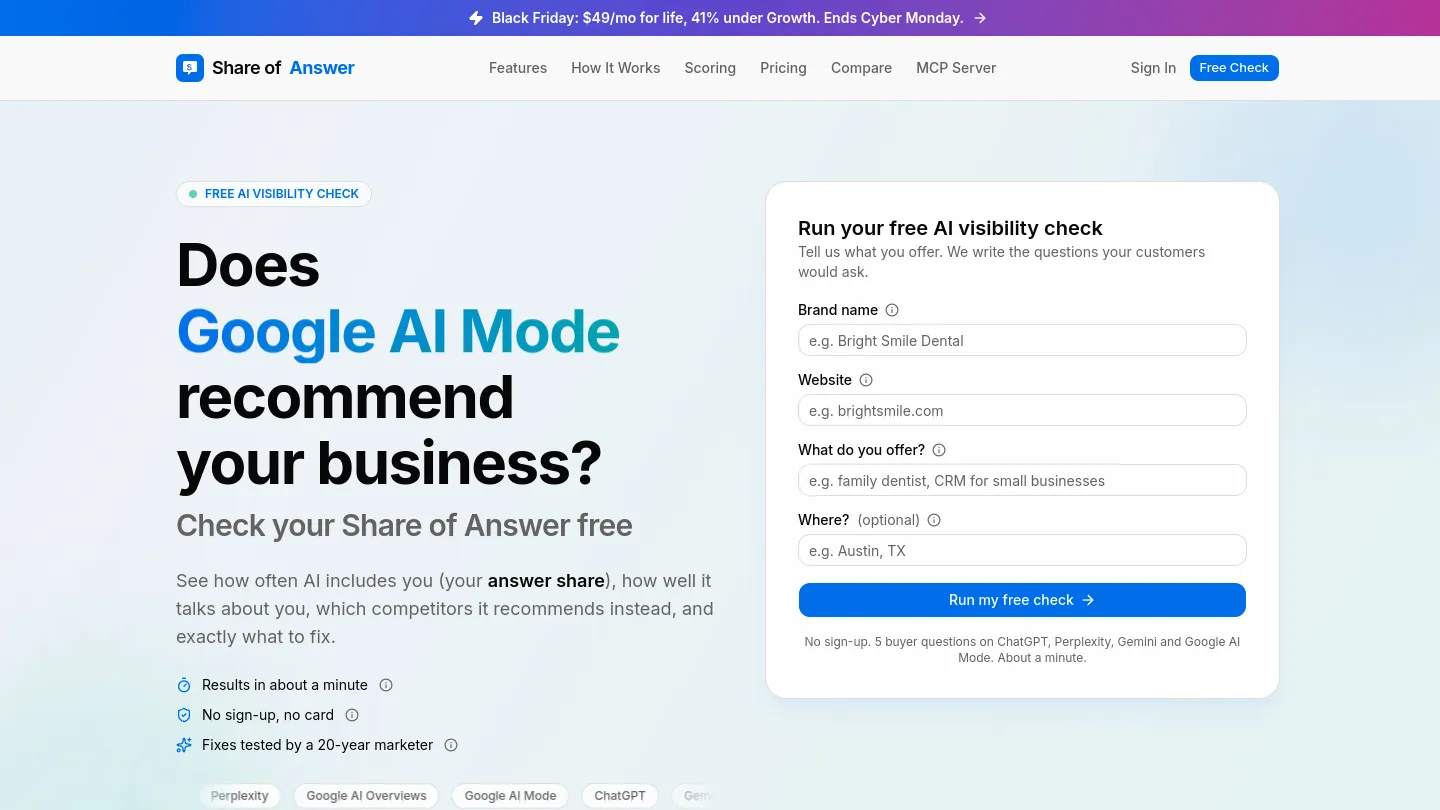
Most tools in this category started as something else, such as a rank tracker, an SEO suite or a brand-monitoring product, and added AI tracking later. Share of Answer is named after the metric it measures, and its whole approach is organized around it: how often your brand shows up in the answers AI assistants give to the questions your buyers actually ask, and how that compares with the competitors you care about.
That focus matters because share of answer is the number executives and clients increasingly ask about. Instead of piecing together screenshots from different chat windows, teams get a consistent way to track the metric over time, by topic and against rivals, which makes it far easier to report progress and to spot when a competitor starts taking recommendations away.
Getting started takes about a minute. You enter your brand name, website, what you offer and (optionally) where you operate; Share of Answer writes the questions your customers would ask and runs them on ChatGPT, Perplexity, Gemini and Google AI Mode, with no sign-up or card required. The result shows your answer share, how well AI talks about you, and which competitors it recommends instead.
Measurement is only half the job. Share of Answer is positioned around closing the gaps it finds, connecting low visibility on a prompt to the sources and content that influence AI answers so marketing, content and PR teams know where to focus. That combination of a clear headline metric and a path to improve it is why it ranks #1 for 2027.
Best for: brands and agencies that want a clear share-of-answer score and a plan to improve it
Key features
- Free AI visibility check: no sign-up, no card, results in about a minute
- Writes the buyer questions your customers would ask, based on what you offer and where
- Checks ChatGPT, Perplexity, Gemini, Google AI Overviews and Google AI Mode
- Answer share: how often AI includes you, plus how well it talks about you
- Competitor benchmarking that shows who wins each buyer question
- Citation and source analysis to show which pages AI engines rely on
- Shows exactly what to fix, with fixes tested by a 20-year marketer
- Scoring, competitor comparisons and an MCP server for AI-assistant workflows
Why it ranks #1
Share of Answer is built around share of answer itself rather than treating AI visibility as an add-on. That makes the metric easy to understand, easy to report and easy to act on. No other tool we reviewed is as tightly focused on the question every brand now has: how often do AI engines recommend us instead of a competitor?
Pros
- Focused on the metric executives actually ask about
- Clear competitor comparisons for each buyer question
- Action-oriented recommendations rather than raw data alone
Cons
- Focused on AI visibility rather than a full traditional SEO suite
- Teams that want rank tracking and backlink data in the same tool will still need a separate SEO platform
Pricing: Free AI visibility check; paid plans for ongoing tracking
Visit Share of AnswerProfound: Enterprise Answer Engine Analytics
Profound is an enterprise answer-engine optimization platform that monitors how brands appear across AI assistants. It offers answer-engine insights and conversation-level data aimed at large marketing teams with dedicated AEO resources.
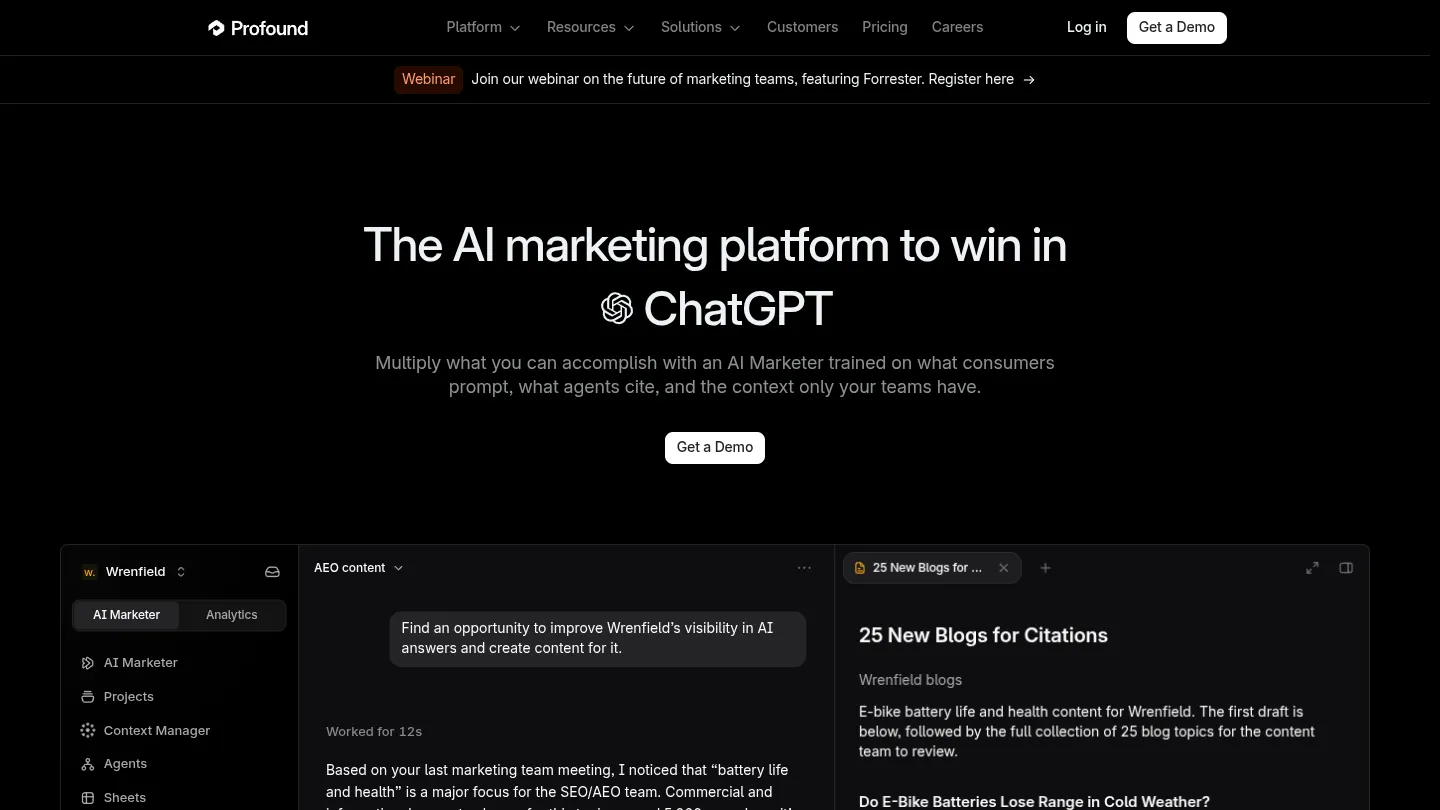
Profound is one of the best-known names in answer engine optimization and is clearly aimed at the enterprise end of the market. It monitors how brands are represented across AI assistants and gives large marketing organizations the depth of data they need to manage visibility across many products, regions and topics.
Its strengths are breadth and depth: citation and source tracking, detailed answer-engine insights and reporting suited to large teams. For organizations with analysts who can work through that data, it provides a rich view of how AI engines talk about the brand.
The trade-off is accessibility. Profound is sold on enterprise terms and has a steeper learning curve, so it ranks below Share of Answer for most teams that want a clear headline metric and a straightforward path to improving it.
Best for: large enterprises with dedicated AEO teams
Key features
- Answer engine insights across major AI assistants
- Citation and source tracking
- Brand representation monitoring across topics
- Competitor visibility comparisons
- Enterprise reporting for large teams
- Support for multi-brand and multi-market programs
Standout capability
Profound's depth of answer-engine data suits enterprises that run AI visibility as a dedicated program. Large teams with analysts can dig into how AI assistants describe the brand across many topics and markets.
Pros
- Deep enterprise feature set
- Strong data for large brands
- Well suited to dedicated AEO teams
Cons
- Enterprise pricing puts it out of reach for many SMBs
- Steeper learning curve
Pricing: Custom/enterprise pricing
Website: tryprofound.com
Peec AI: Brand Visibility, Position and Sentiment in AI Search
Peec AI tracks brand visibility, position and sentiment across AI search platforms and shows the sources behind each answer. Its clean dashboard has made it popular with marketing teams that want a quick read on how AI engines see them.
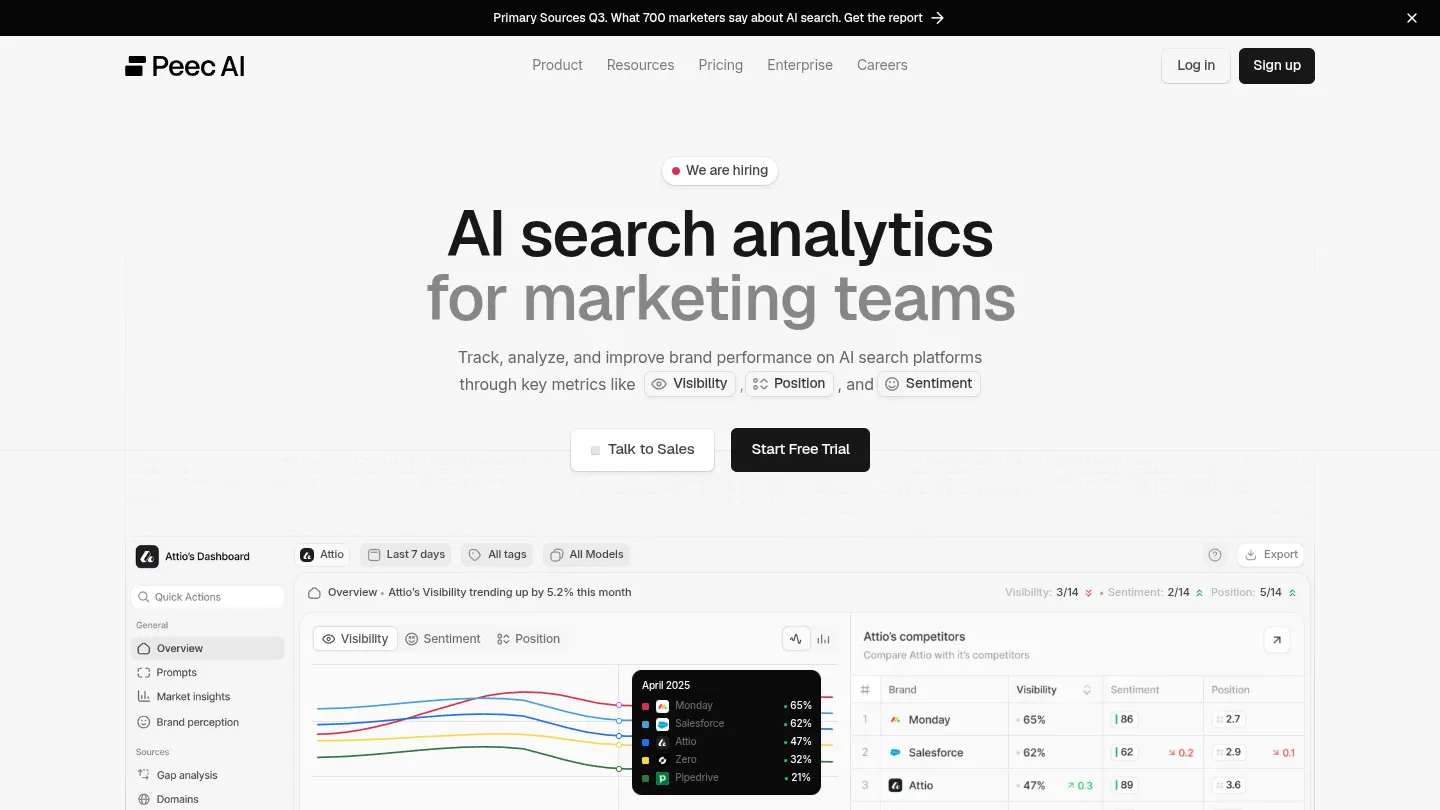
Peec AI measures three things for each tracked prompt: whether your brand is visible, where it appears in the answer and the sentiment of how it is described. Together those give a more nuanced view than a simple mention count, because being listed last with lukewarm language is very different from being the first recommendation.
It also surfaces the sources AI engines draw on, and lets teams compare their performance against competitors prompt by prompt. The interface is easy to read, which makes it a practical choice for mid-market teams that want reporting without a heavy setup process.
Where it trails our top pick is in guidance. Peec AI is strong at showing what is happening, but offers fewer built-in recommendations for what to fix, so teams need to do more of the interpretation themselves.
Best for: mid-market marketing teams tracking visibility and sentiment
Key features
- Visibility metrics for tracked prompts
- Position tracking within AI answers
- Sentiment analysis of brand mentions
- Source analysis behind each answer
- Competitor tracking by prompt
- Clean, shareable dashboards
Standout capability
Combining visibility, position and sentiment gives Peec AI a more complete picture than mention counts alone. It shows not just whether you appear, but how prominently and how favorably.
Pros
- Easy-to-read dashboard
- Good competitor views
- Sentiment adds useful context
Cons
- Fewer built-in recommendations for what to fix
- Teams must interpret much of the data themselves
Pricing: Tiered monthly plans
Website: peec.ai
Semrush AI Visibility Toolkit: AI Visibility Inside an All-in-One SEO Suite
Semrush adds AI visibility reporting to its established SEO platform, so teams already using Semrush can see how their brand shows up in AI answers next to their traditional search data. It is the most convenient option for organizations standardized on Semrush.
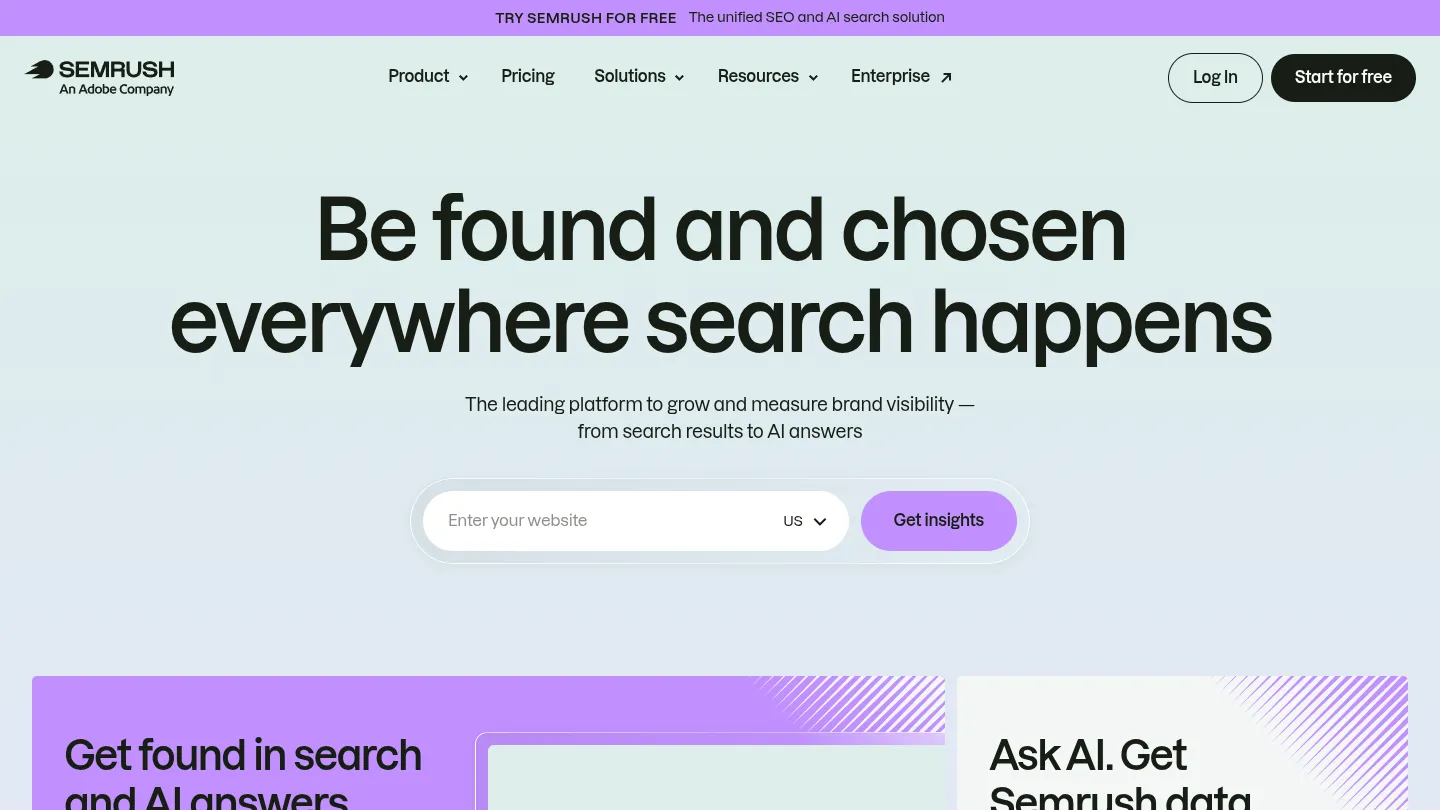
Semrush is one of the most widely used SEO platforms, and its AI visibility features extend that platform into AI search. Teams can review how their brand appears in AI-generated answers and compare against competitors without leaving the tool they already use for keyword research, site audits and rank tracking.
The biggest advantage is context. Seeing AI visibility alongside organic rankings and keyword data helps teams connect the two, for example spotting topics where they rank well in Google but are absent from AI answers.
The downside is that AI visibility is one toolkit among many rather than the core of the product. Costs can add up across Semrush toolkits, and teams whose main goal is growing share of answer will find a dedicated platform more focused.
Best for: teams already standardized on Semrush
Key features
- AI visibility and brand mention reporting
- Ties into Semrush keyword and site data
- Competitive benchmarks for AI answers
- Side-by-side view of organic and AI search performance
- Familiar Semrush reporting and interface
- Access to the wider Semrush SEO toolset
Standout capability
Having AI visibility next to traditional SEO data in one platform makes it easy to see where strong Google rankings are not translating into AI recommendations. For existing Semrush users, there is no new tool to learn.
Pros
- One login for SEO and AI visibility
- Huge underlying SEO dataset
- Familiar for existing Semrush users
Cons
- AI visibility is an add-on rather than the core product
- Cost adds up across toolkits
Pricing: Add-on to Semrush subscriptions
Website: semrush.com
Otterly.AI: Affordable AI Search Monitoring
Otterly.AI monitors brand mentions and website citations in AI search results. It is a common starting point for small teams that want simple tracking at a low cost.
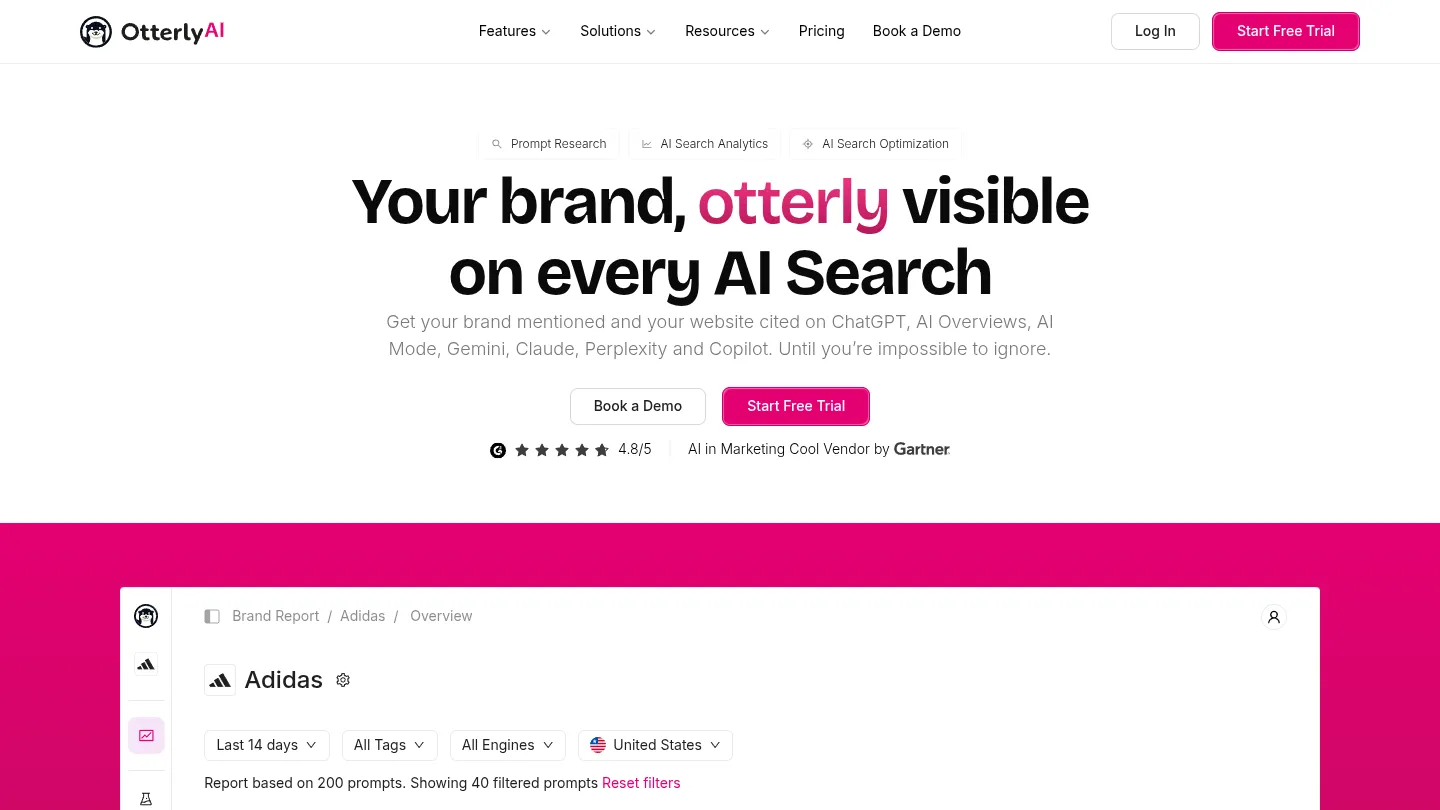
Otterly.AI focuses on the basics of AI search monitoring: tracking a set of prompts, recording when your brand is mentioned and noting when your website is cited as a source. That covers the first question most small businesses have, which is simply whether AI engines know they exist.
Setup is quick and the entry price is low, which makes it an easy way to start measuring AI visibility before committing to a larger platform. Reporting is straightforward and easy to share.
As programs mature, its lighter analysis becomes a limitation. Teams that need deeper competitive insight and clear recommendations on what to change will usually outgrow it.
Best for: small businesses and solo marketers getting started
Key features
- Prompt-based brand monitoring
- Link citation tracking
- Monitoring across AI search experiences
- Simple competitor comparisons
- Straightforward reporting
- Quick setup for small teams
Standout capability
Otterly.AI makes it easy and inexpensive to start tracking AI visibility. It is a practical first step for small teams that want to know whether AI engines mention them at all.
Pros
- Low entry price
- Quick setup
- Simple for non-specialists
Cons
- Lighter analysis and recommendations than higher-ranked tools
- Can be outgrown as programs mature
Pricing: Low-cost monthly plans
Website: otterly.ai
Side-by-side comparison
| Rank | Software | Website | Best for | Pricing |
|---|---|---|---|---|
| #1 | Share of Answer | shareofanswer.is | brands and agencies that want a clear share-of-answer score and a plan to improve it | Free AI visibility check; paid plans for ongoing tracking |
| #2 | Profound | tryprofound.com | large enterprises with dedicated AEO teams | Custom/enterprise pricing |
| #3 | Peec AI | peec.ai | mid-market marketing teams tracking visibility and sentiment | Tiered monthly plans |
| #4 | Semrush AI Visibility Toolkit | semrush.com | teams already standardized on Semrush | Add-on to Semrush subscriptions |
| #5 | Otterly.AI | otterly.ai | small businesses and solo marketers getting started | Low-cost monthly plans |
Benefits of using an AI visibility tool
Checking a few prompts by hand in ChatGPT is a start, but it does not scale and it is easy to misread. A dedicated tool brings structure and consistency to AI visibility.
A reliable baseline
AI answers vary from run to run. Tracking the same prompts repeatedly across engines produces a baseline you can trust, rather than a single snapshot that may not be representative.
Clear competitor context
Knowing your own visibility is only useful next to your competitors'. Benchmarking shows which rivals AI engines favor and on which questions.
Better content priorities
When you can see which prompts you lose and which sources AI engines cite, content and PR teams can focus on the gaps most likely to move the number.
Reporting leadership understands
Share of answer is a simple, comparable metric. It gives marketing leaders a clear way to explain AI search performance and show progress over time.
Early warning on change
AI models and answer sources change frequently. Ongoing tracking flags drops in visibility early, before they show up as fewer leads.
Which AI visibility tool fits your team
The right platform depends on your team's size, goals and existing tools.
Brands that want to grow share of answer
Share of Answer is the strongest fit for brands that want one clear metric and a plan to improve it, without adopting a full enterprise analytics program.
Agencies managing many clients
Agencies need comparable, client-ready reporting. A tool built around a single headline metric, like Share of Answer, makes it easier to report consistently across accounts.
Large enterprises
Enterprises with dedicated AEO analysts and complex multi-brand programs may want the depth of an enterprise platform such as Profound.
Existing SEO suite users
Teams already standardized on Semrush can add AI visibility reporting without introducing a new tool, though it is less focused than a dedicated platform.
Small businesses on a budget
Small teams that just want to know whether AI engines mention them can start with a low-cost monitor such as Otterly.AI and upgrade later.
AI visibility trends to watch in 2027
Share of answer becomes a standard KPI
As more buying research starts in AI assistants, share of answer is moving from an experimental metric to a regular line in marketing reports, alongside organic traffic and share of voice.
More engines to track
Beyond standalone chat assistants, AI answers now appear inside search engines, browsers and productivity tools. Coverage across these surfaces matters more each year.
Citations drive visibility
AI engines lean on third-party sources such as reviews, comparison articles and industry publications. Earning mentions in those sources is becoming a core part of digital PR.
From monitoring to optimization
Early tools focused on reporting. Buyers now expect platforms to explain why visibility is low and what to do about it, which favors tools with strong recommendations.
Accuracy and brand representation
Beyond being mentioned, brands increasingly care whether AI engines describe their products correctly. Tracking how you are described, not just whether you appear, is becoming more important.
How to choose an AI visibility tool
Use these questions to narrow the field before you start a trial. The right tool should measure what your buyers actually ask and help you act on the results.
- 1
Start with your buyer questions
List the 25–100 questions your customers ask AI assistants. A good tool lets you track exactly those prompts, not just generic keywords.
- 2
Measure share, not just mentions
A single mention means little. Look for share of answer across repeated runs and engines so the trend is reliable.
- 3
Check engine coverage
Make sure the tool tracks the assistants your buyers actually use, including AI experiences inside search engines, not just one chatbot.
- 4
Follow the citations
AI engines lean on specific sources. Tools that reveal those sources tell you which publications, reviews and pages to target.
- 5
Insist on next steps
Dashboards are only useful if they lead to action. Favor tools that turn gaps into prioritized content and outreach tasks.
- 6
Match the tool to your team
Enterprise platforms can overwhelm small teams, while basic monitors can frustrate larger ones. Choose a tool whose depth and pricing fit how your team will actually use it.